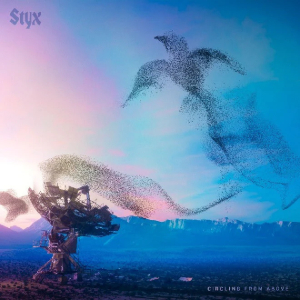
Circling From Above (2025)

  1. Circling From Above
  2. Build and Destroy
  3. Michigan
  4. King of Love
  5. It's Clear
  6. Forgive
  7. Everybody Raise A Glass
  8. Blue Eyed Raven
  9. She Knows
  10.Ease Your Mind
  11.The Things That You Said
  12.We Lost the Wheel Again
  13.Only You Can Decide
There are few topics guaranteed to start an argument among Styx fans faster than the departure of Dennis DeYoung. More than two decades later, people are still choosing sides, revisiting old grievances, and debating whether the band was liberated or permanently damaged by his exit. Personally, I've never been entirely convinced by either camp. DeYoung was certainly capable of steering the group into some questionable territory, particularly during the early 1980s, but he also possessed an undeniable gift for taking a collection of musical ideas and shaping them into memorable songs that people actually remembered a week later.
Listening to the modern incarnation of Styx, one increasingly realizes just how important that particular skill was.
The frustrating thing about Circling From Above is that the talent is obviously present. These musicians can play. In fact, they can probably play circles around many of their contemporaries. The problem is that technical proficiency and songwriting are not necessarily the same thing. Time and again, this album presents interesting ideas, clever arrangements, impressive harmonies, and intricate musicianship, only to forget the most important question: where's the song?
There's now a sixth member in the fold. Will Evankovich has become a significant contributor, handling vocals, songwriting duties, and guitar work. His presence is certainly noticeable throughout the album, and to be fair, his contributions are perfectly respectable. Unfortunately, his arrival hasn't changed the band's overall approach. If anything, it seems to reinforce it.
The material rarely breathes. Rather than building memorable hooks or choruses, Styx appear determined to overwhelm the listener with wave after wave of progressive flourishes. There are keyboards everywhere. Harmonies pile upon harmonies. Mythological imagery comes flying out of the speakers at regular intervals. One can almost imagine the band gathered in the studio asking themselves, "How many musical ideas can we fit into this section?" rather than asking whether any of them might actually stick in the listener's memory.
It's undeniably impressive. It's also surprisingly forgettable.
Perhaps the biggest disappointment remains the continued marginalization of James "J.Y." Young. This has now become a recurring issue across several albums. Once upon a time, Styx benefited enormously from having three distinct creative voices pulling the music in different directions. DeYoung brought the theatrical flair, Tommy Shaw brought the melodic craftsmanship, and J.Y. supplied a healthy dose of grit and muscle. That balance was one of the band's greatest strengths.
Now J.Y. seems to appear briefly, almost as a contractual obligation. He pops up for part of a song, reminds everyone he's still alive, and then quietly disappears again. Whether this is the result of internal politics, creative decisions, or simple circumstance is impossible to know, but the loss is noticeable. The heavier edge he traditionally brought to the band is largely absent. Styx has gradually transformed from three distinct songwriters creating something larger than themselves into what increasingly feels like the “Tommy Shaw and Lawrence Gowan Show”.
The individual pieces remain interesting. Build and Destroy sounds remarkably like an attempt to channel the spirit of Yes. Everybody Raise A Glass may well be the best Queen song that Queen never actually recorded. Meanwhile, We Lost the Wheel Again wears its admiration for The Who so openly that Pete Townshend should probably receive a royalty check.
The problem is that homage can only take a band so far.
When all is said and done, one wishes Styx would spend less time emulating their influences and more time sounding like Styx. The ingredients are all here. The musicianship is excellent. The production is polished. The vocals remain strong. Yet the album never quite develops the identity necessary to elevate it beyond an interesting exercise in progressive rock craftsmanship.
Some fans will undoubtedly love this. Those who have a particular fondness for the band's more adventurous early work, such as The Serpent is Rising, may find plenty to admire. Listeners whose hearts belong to albums like Pieces of Eight or Paradise Theatre, however, may find themselves longing for the days when Styx balanced technical excellence with songs memorable enough to become part of the soundtrack of people's lives.
In the meantime, those old records are still sitting on the shelf and they, fortunately, haven't aged a day.
Go back to the main page