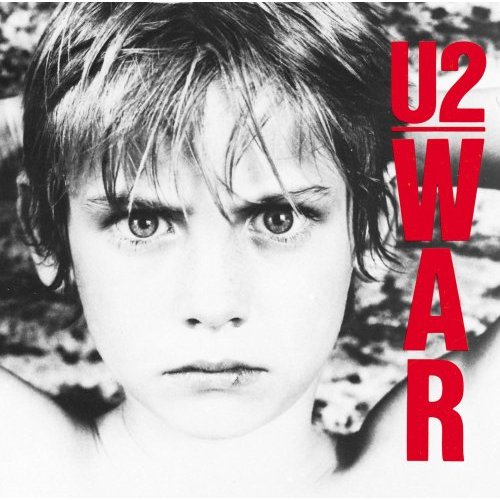
War (1983)

 1. Sunday Bloody Sunday
 2. Seconds
 3. New Years Day
 4. Like a Song
 5. Drowning Man
 6. The Refugee
 7. Two Hearts Beat As One
 8. Red Light
 9. Surrender
 10.40
It didn’t take long for U2 to grow up. By the time of their third studio release, War, the band had shed nearly all remnants of their wide-eyed beginnings. What emerged was something leaner, louder, and, for the first time, openly political. This was not the youthful introspection of Boy or the spiritual searching of October. This was a band staring out at the world and responding with clenched fists and thunderous declarations.
The cover told you as much. A close-up of a boy’s face—presumably the same child from Boy—but this time there’s no innocence. Just hard eyes, a furrowed brow, and the unmistakable gaze of someone who has seen too much too soon. It’s an image that perfectly frames the tone of the album: weary, confrontational, and utterly aware.
Though not every track is overtly topical, much of War plays like a dispatch from the front lines. Sunday Bloody Sunday, which opens the album, is its towering centerpiece—a bracing commentary on the troubles in Northern Ireland, made all the more powerful by Larry Mullen Jr.’s martial drumming and Bono’s impassioned delivery. Seconds tackles nuclear anxiety with jittery urgency, while New Year’s Day draws inspiration from the Polish Solidarity movement and pairs it with one of the band’s most memorable piano motifs.
What’s striking is how the band manages to sound angrier, louder, and more forceful without losing control. Larry Mullen Jr. in particular dominates the mix here—his drums thunder with purpose, sometimes more front and center than the vocals themselves. But that’s entirely appropriate. This is music built for rallying cries, not whispered sentiments.
That said, the album doesn’t abandon melody or movement. Two Hearts Beat As One offers a bit of rhythmic relief—its buoyant bass line and danceable feel harken back to the band’s earlier work, though it never quite reached the commercial heights one might have expected. Surrender brings a certain crooning charm to the proceedings, while Like a Song... remains one of the most criminally overlooked tracks in the band’s catalog—a kinetic, passionate blast that could easily have fit on Boy had it not been cloaked in such fury.
And then there are the unexpected moments. An electric violin slices through Sunday Bloody Sunday with a stark beauty. A trumpet adds a strange, almost mournful brightness to Red Light. None of it feels out of place. If anything, these flourishes prove just how confident the band had become. By the time Drowning Man and the closing benediction 40 arrive, the album has made its full arc—raging, reflecting, and ultimately resolving.
Despite its power, War wasn’t an immediate breakthrough in the United States. While it raced up the charts in the UK and across Europe, U2 were still something of a secret on the other side of the Atlantic. That would soon change, thanks in no small part to a rising cable network called MTV.
Many longtime fans point to War as the album that cemented their allegiance. Some purists, ironically, would later depart once the band achieved global superstardom. But that’s beside the point. War was—and remains—a pivotal moment. The sound of four young men refusing to be boxed in, daring to speak up, and doing so with clarity, conviction, and style.