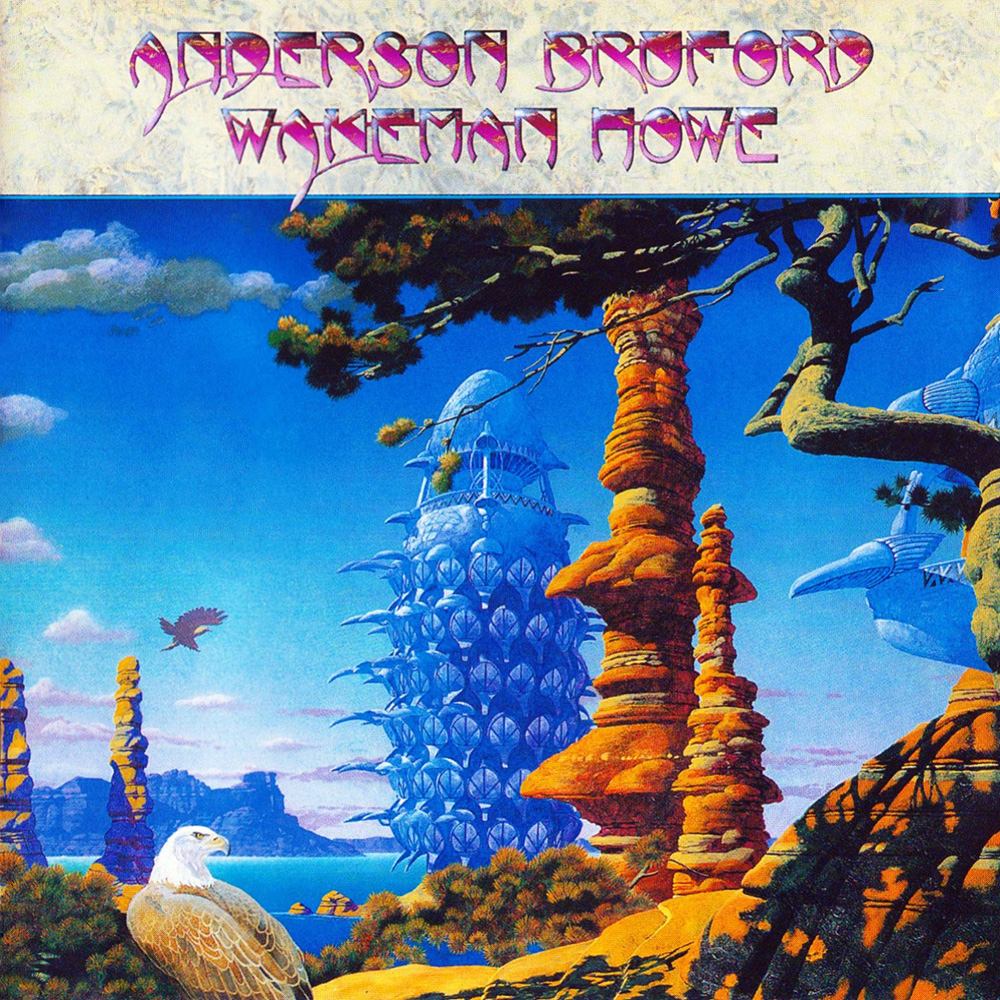
Anderson Bruford Wakeman Howe (1989)

1. Themes
2. Fist of Fire
3. Brother of Mine
4. Birthright
5. The Meeting
6. Quartet
7. Teakbois
8. Order of the Universe
9. Let's Pretend
Technically speaking, Anderson Bruford Wakeman Howe isn’t a Yes album. But it sure *wanted* to be. After growing frustrated with the Rabin-led version of the band, Jon Anderson decided to reunite with some of the “classic” members to try to make an album more in line with what he thought Yes should sound like. Legal wrangling stopped them from using the actual band name, so they simply used their own surnames as the band title—a kind of winking nod to fans who would immediately know who they were. They even rang up Roger Dean to supply the unmistakable, psychedelic cover art to complete the illusion. The goal? Recapture the early '70s magic and shed the sleek, poppy 80s approach. The result? Sadly, a big, sprawling disappointment.
The biggest letdown is that, for all the branding and nostalgic cues, this record doesn’t sound much like vintage Yes at all. If anything, it sounds like a band uncomfortably trying to sound contemporary but having no idea how. From the opening track Themes, you get a sense of trouble. It begins innocently enough with Rick Wakeman doing his delicate, sparkly keyboard intro—classic enough. But then Bill Bruford enters the picture, and everything falls apart. Instead of his signature nimble, jazz-inflected drumming, we get an onslaught of tinny, artificial electronic percussion: *THWACK-THWACK-DU-DU-THWACK-THWACK*. It’s less “progressive rock” and more like the soundtrack to a low-budget Caribbean cruise commercial. And when Jon Anderson does start singing, it’s not the angelic croon you remember—more of a strained shout, pushing the whole thing into self-parody.
After that opening misfire, you hold out hope it’ll get better. And it sort of does. Very slightly. But for the most part, the album feels like a group trying too hard to be “artsy” and “different” without actually delivering anything enjoyable or coherent. Sure, no one expected a carbon copy of Close to the Edge—though many fans would have welcomed it—but this needed to at least be listenable. Too often, it isn’t. Honestly, if this had been the only alternative to 90125 or Big Generator, it would be easy to argue the band should have stayed in the 1970s forever.
In classic Yes fashion, they pad the tracklist with several “epics” in the 7–10 minute range, divided into multiple movements or sections. The problem is, none of them work all the way through. Order of the Universe and Brother of Mine have moments—bits of catchy, melodic promise—but they’re smothered under clunky transitions, aimless structures, and production choices that make you wonder if anyone actually listened back to the final mixes. Instead of feeling like grand musical journeys, these songs come off like half-finished sketches glued together without much thought.
Ironically, it’s the short, modest songs that offer the best glimpses of what this lineup could have been. The Meeting and Let’s Pretend are simple and understated, with Anderson’s gentle vocals riding soft keys and Steve Howe’s acoustic guitar. No overbearing Wakeman bombast, no headache-inducing Bruford electronic beats—just restrained, tasteful, recognizably “Yes”-like beauty. It’s proof they *could* have done it right if they hadn’t been so determined to prove how “modern” they were.
Speaking of Howe—where *was* he on this record? For someone whose guitar defined so much of the classic Yes sound, he’s practically a ghost here. Nothing he plays leaves much of an impression, and you’re left wondering if he spent most of the sessions at the coffee machine. The absence of Chris Squire is even more glaring. Instead, they brought in Tony Levin—an undeniably talented player best known for King Crimson—but here his bass lines are forgettable, adding nothing to the songs that needed so much more.
Of course, they toured. And wisely, they filled their sets with plenty of old Yes staples—the very music this album was supposedly trying to reclaim. The irony is hard to miss. For a project pitched as a return to roots and a corrective to the poppy, Rabin-led Yes, Anderson Bruford Wakeman Howe ended up alienating old fans while offering nothing compelling to bring in new ones. It’s the sound of a reunion that wanted to recapture the past but forgot what made that past so good in the first place.
Go to the Next Review
Go back to the main page