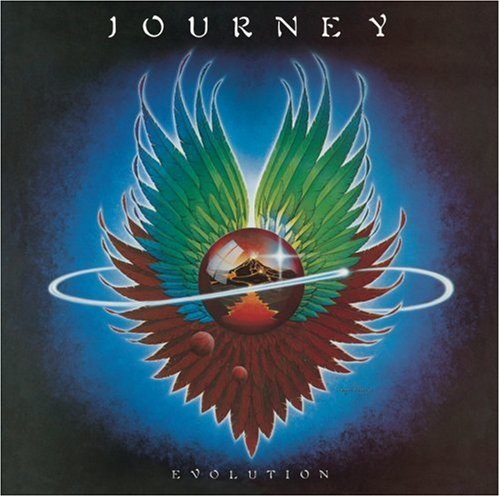
Evolution (1979)

 1. Majestic
 2. Too Late
 3. Lovin' Touchin' Squeezin'
 4. City of the Angels
 5. When You're Alone (It Ain't Easy)
 6. Sweet and Simple
 7. Lovin' You is Easy
 8. Just the Same Way
 9. Do You Recall
 10.Daydream
 11.Lady Luck
It’s remarkable, really, just how deftly Journey managed to make such a dramatic stylistic shift on Infinity—and to do it not only convincingly, but with warmth, finesse, and a surprising degree of critical and commercial acceptance. With Evolution, the band essentially picked up where they left off. There’s a new drummer in the mix—Steve Smith, replacing the disenchanted Aynsley Dunbar—and his contribution is no mere background detail. His playing brings a crisper, more agile texture to the sound. But beyond that, Evolution seems less a step forward and more a firm declaration: this is who we are now.
In that light, the album’s title feels mildly misleading. “Evolved,” perhaps, but not transformed. The leap had already occurred. This was confirmation, not innovation. Still, if the band had become a different animal, they were now fully grown—and fully aware of what they were doing.
One might glance over the track list and come away unimpressed. There’s no embarrassment of riches here in terms of chart-toppers. Aside from the brilliant and soulful Lovin', Touchin', Squeezin', there’s little by way of obvious hit material. That, however, would be a mistake in judgment. This is a record that rewards time and attention. It’s not a singles collection. It’s a meticulously crafted body of work, rich in songcraft and alive with musicianship.
Steve Perry, now firmly at the center of the operation, had begun to win over audiences en masse. His voice—equal parts power and silk—defined the band’s new identity. Journey, by this point, had become the very model of what would soon be dubbed “arena rock.” Big choruses, big emotion, big sound. The formula was set, and Evolution delivers it with precision and confidence.
Yes, the criticism would follow in time. “Too commercial,” some would say. “Sellouts,” others would sneer. And yet, the music on Evolution—like its predecessor—is cut from a finer cloth than those accusations suggest. It may be polished, yes. It may be radio-friendly. But it is also genuine, muscular, and, at times, quite beautiful. For those who found themselves put off by Journey’s later ‘80s ubiquity, this album offers a compelling case that the band’s popularity wasn’t an accident. They earned it—track by track.
Go back to the main page
Go To Next Review