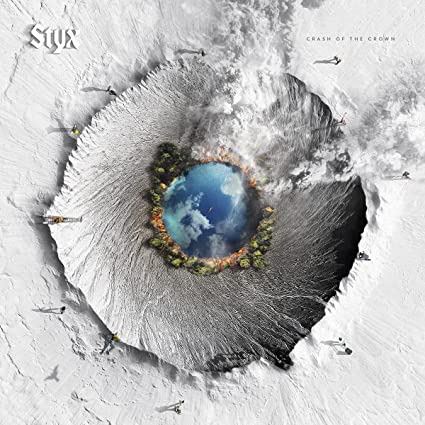
Crash of the Crown (2021)

  1. The Fight of our Lives
  2. A Monster
  3. Reveries
  4. Hold Back the Darkness
  5. Save Us From Ourselves
  6. Crash of the Crown
  7. Our Wonderful Lives
  8. Common Ground
  9. Sound the Alarm
  10.Long Live the King
  11.Lost at Sea
  12.Coming Out the Other Side
  13.To Those
  14.Another Farewell
  15.Stream
Few bands have experienced a steeper decline in my personal estimation than Styx. When I was fifteen years old, these guys could do no wrong. I bought the records, defended them against critics, and probably knew most of their lyrics by heart. Fast forward several decades and I now find myself approaching each new Styx release with a mixture of caution, skepticism, and, if I'm being completely honest, mild dread. It's not that the band has suddenly become incompetent. Quite the opposite. The musicianship remains impressive. The problem is that somewhere along the way they seem to have forgotten what made them great in the first place.
Like most veteran bands, Styx has endured its share of internal politics, personnel changes, and bruised egos. That's hardly unusual in the music business. The departure of Dennis DeYoung in 1999 remains a dividing line among fans, many of whom have never quite recovered from the split. Personally, I've never considered myself a member of the Dennis DeYoung fan club. In fact, I thought Cyclorama, the band's first studio album after his departure, was surprisingly good and demonstrated that Styx could continue without him. For years I maintained that fans who automatically dismissed every post-DeYoung release were allowing nostalgia to cloud their judgment.
Listening to The Mission and now Crash of the Crown, however, I find myself wondering whether those diehards may have been onto something after all. Not because Dennis DeYoung was some irreplaceable genius, but because the band increasingly sounds like a ship sailing without a rudder. There is certainly no shortage of ambition here. There are grand concepts, elaborate arrangements, impressive harmonies, and enough progressive flourishes to satisfy listeners who believe every song should contain seven movements and a philosophy lecture.
What there isn't, unfortunately, are many actual songs.
That may sound harsh, but it's difficult to avoid the conclusion. The classic formula of verse, chorus, verse, chorus, bridge, and memorable hook seems to have become unfashionable within the Styx camp. Instead, the band appears determined to bombard the listener with layer upon layer of musical ideas, each one competing for attention. The result is music that sounds busy without being memorable. One hears plenty of notes, plenty of effort, and plenty of technical proficiency, yet very little sticks in the mind after the album ends. Even repeated listens fail to reveal the kind of melodies that once came so naturally to this band.
A perfect example can be found in To Those. To begin with, the song borrows rather heavily from the chorus of Pieces of Eight from the classic album of the same name. That alone wouldn't necessarily be a problem. Artists borrow from themselves all the time. The issue is in the execution. On Pieces of Eight, the famous chorus was carefully earned. The arrangement slowly built toward it, creating anticipation and emotional payoff. By the time the listener arrived at the big moment, it felt significant. Here, Styx dispenses with such niceties and simply launches the chorus directly at the listener almost immediately. Rather than inspiring participation, it feels like being ambushed. One is less inclined to sing along and more inclined to seek shelter under the nearest piece of furniture.
Sadly, that criticism applies to much of the album. There is an enormous amount of activity but very little genuine connection. The overarching concept may well be profound, but the band forgets an important truth: listeners generally need compelling songs before they begin caring about grand concepts. Without that foundation, the entire exercise feels strangely hollow.
One bright spot throughout the proceedings is drummer Todd Sucherman. Long regarded as one of the finest drummers in rock music, he is given several opportunities to shine here. His intricate fills, technical precision, and occasional solo passages provide some of the album's most engaging moments. At times, his playing cuts through the clutter and reminds listeners just how gifted a musician he truly is. In fact, one can't help but wonder how much more attention and acclaim Sucherman might receive were he performing in a band whose songwriting was equal to his abilities.
The band, for some strange reason, seems to want to go back to their Wooden Nickel days as opposed to the years where they were filling the charts with triple-platinum albums. Maybe some want that, but definitely not me.
Go back to the main page
Go to the Next Review